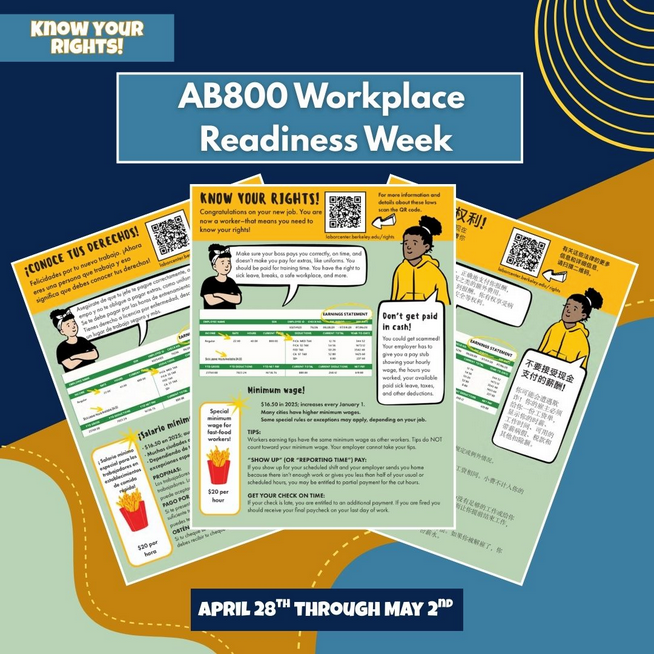
AB800 (chaptered in 2023) is a law that designates the week of April 28th as Workplace Readiness Week, and requires school districts to integrate educational programming around young worker rights and the labor movement into their curriculum.
Schools are required to provide students with specific information about various topics in young worker rights and worker health and safety. Specific requirements are detailed below.
What is required under AB800:
- Additional educational programing related to the topics below
- A young worker rights fact sheet must be distributed to each high school junior and senior. Schools are encouraged to provide this fact sheet. To access the fact sheet in additional languages, click here.
What programs are included under this mandate?
- All public high schools including charter schools (traditional and alternative pathways)
How do I provide more information about AB800 to my school?
- Webinar for School Administrators
- Recorded webinar that provides a summary of the requirements of AB800
- Features a Q&A with Erle Hall, Educational Program Consultant of CDE
Specific Topic Requirements of AB800
Below are the specific requirements as described in the language of AB800. Included in each topic are ideas for activities and resources to teach about the topics.
Local, state, and federal laws regarding each of the following issues:
Child Labor
- Five Day Learning Cycle for Workplace Readiness Week (from the Young Workers Education Project)
- Day 1 Lesson Plan (focuses on the history of child labor)
- Overview of Current State of Child Labor
Wage and hour protections
- Activity: Wage Theft: What Young Workers Need to Know
- 45-55 minutes
- Slide deck with overview of wage theft, and information about paychecks; Includes activity for students to practice reading through scenarios to determine if wage theft occurred
Worker safety
- Teens: Know Your Rights at Work
- Hazard Mapping Activity (Lesson 2 of the Youth at Work: Talking Safety Curriculum)
- Lecture on common workplace hazards and activity where students draw out hazards in common workplaces for young workers
- Safety Pyramid (Lesson 3 of the Youth at Work: Talking Safety Curriculum)
- Lecture on most effective ways to address a workplace hazard, with a game for students to practice developing solutions to prevent common workplace injuries
- Elena’s Story (Video)
- Work permit quiz (Series of short youtube videos to review important
- Series of short youtube videos that reviews important topics in young worker health and safety
- Short quiz to test students’ knowledge on aforementioned topics. Students receive a certificate upon successful completion.
- Omar’s Story
Workers’ compensation
- Workers’ Compensation Kahoot
- 10-question kahoot that follows a worker that is injured at work as she navigates the workers’ compensation system.
- Lesson plan includes a factsheet with more information
Paid sick leave
- Five Day Learning Cycle for Workplace Readiness Week Day Three Lesson plan focuses on Rights
Prohibitions against retaliation
- Five Day Learning Cycle for Workplace Readiness Week
- Day Four Lesson plan focuses on concerted action being a protected worker right
The right to organize a union in the workplace
- Collective action activity
- A 50-minute interactive curriculum for students to learn about labor unions and workers’ right to organize their workplace. The lesson plan includes two options for union case studies, current Starbucks workers organizing or the Sanitation workers strike from 1968.
The labor movement’s role in winning the protections and benefits described in subparagraphs (A) to (G), inclusive.*
An introduction to state-approved apprenticeship programs in California, how to access them, and how they can provide an alternative career path for those who do not attend college.
- To learn more about apprenticeship programs in California visit the Division of Apprenticeship Standards and their apprenticeship page.
How can I educate myself on young worker health and safety?
- To learn more about work permit requirements for young workers, visit the California Department of Education
- Read UCLA’s report on the state of child labor in CA: “California’s Future is Clocked In: The Experiences of Young Workers”
- Learn about young workers in agriculture: “California’s Child Farmworkers: Exhausted, Underpaid and Toiling in Toxic Fields”
- Listen to the New York Times’ Daily episode A New Child Labor Crisis in America to learn about how child labor laws affect young worker health and safety
- Learn more about young worker protections: Young Workers Have Rights: What to Know About Your Labor Protections
- Check out this article about young workers organizing: The New Labor Movement is Young, Worker Led, and Winning
- Learn about child exploitation and trafficking here